





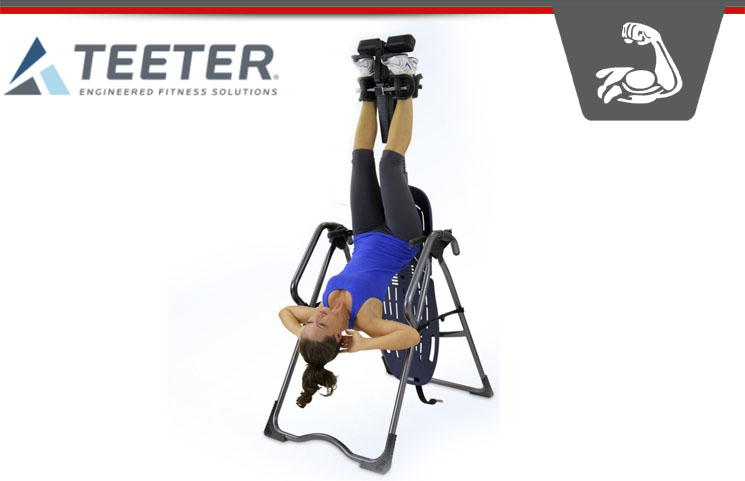
With time, the effects of gravity and the natural aging process can cause the discs in the spinal cord to deteriorate, causing mild to severe pain. Affected individuals may undergo a variety of treatments, including physical therapy, epidural injections, use of a TENS unit, and chiropractic manipulation. Oftentimes, sufferers resort to taking pain medicine several times a day and can end up requiring surgery. However, the makers of Teeter believe that their product can offer a completely different solution.
The daily use of Teeter may be able to help those suffering from back pain by utilizing inverted decompression, which can target the source of the pain, rather than covering it up with medication. The manufacturer claims that just a few minutes each day can help to:
- Relieve pain by relaxing back muscles, rejuvenating discs, and reducing pressure on spinal nerves, effectively decompressing the spine
- Ease the consequences of stress by releasing tension in the shoulders, neck, and back
- Increase flexibility by stretching muscles and improving functional fitness to make way for an active, healthy lifestyle
- Build core strength through inverted exercise
- Improve circulation
Teeter is meant to naturally targets back pain by using body weight and gravity to decompress the spinal. Some individuals feel the benefits of inversion immediately. Others may notice a change over a two to three week period, as they routinely use their Teeter and grow accustomed to inverting.
Study May Back Up Effectiveness of Teeter
A preliminary pilot study reported that “Intermittent traction with an inversion device resulted in a significant reduction in the need for surgery.” The study was published in the US National Library of Medicine for the National Institute of Health under the title “Inversion therapy in patients with pure single level lumbar discogenic disease: a pilot randomized trial.” The study, although containing only twenty-four patients, found a significant difference between the control group and the test group.
The study, which took place in Tyne, UK, was a trial of patients awaiting surgery for lumbar discogenic disease. The disease is a common cause of lower back pain and tends to occur as a natural part of the aging process of the spine. This condition happens when the cushion-like discs separating the vertebrae in the spine begin to deteriorate. The vertebrae may rub bone on bone and pinch the surrounding nerves, causing pain that is sometimes extreme and debilitating.
Details of Inversion Therapy Study
Patients were randomly separated into two categories: those treated with physiotherapy alone and those treated with both physiotherapy and an inversion device. Thirteen patients received the inversion treatment, which, according to the manufacturer’s website, included four weeks of using various Teeter models. Patients used the inversion table three times weekly. Each session involved only two minutes of inversion up to a maximum of six times.
Following the treatment, blind observers made assessments to measure various outcomes. The treatment was considered a success if patients did not require surgery. In the control group of those who only had physiotherapy, only two patients averted surgery; whereas ten patients in the inversion group did not require back surgery. The researchers concluded that inversion, such as that provided by Teeter, can be an effective option for patients whose only other alternative is surgery.
How Does Teeter Work?
To use a Teeter Inversion Table, customers need to adjust it to their height, lock themselves in, and recline. The product does require some assembly, but the manufacturer states that it is shipped nearly 85% pre-assembled. Instructions and an Assembly and Use DVD are included, and assembly instructions and owner’s manual are available for download on the company website. Teeter states that it should only take twenty to thirty minutes to set up the inversion table.
Once on the Teeter table, users can use simple arm motions to shift their body weight and control both rotation and angle. While greater angles create better results, customers can begin feeling benefits at only twenty degrees. The manufacturer recommends aiming for a sixty-degree angle to fully decompress the spine and reports that more than half of all clients routinely do a “lock-out,” or full inversion at 90 degrees. The Angle Tether can be used to pre-set the angle of the inversion, ensuring that the table does not invert farther than a user intends.
The manufacturer advises users to only invert for several minutes at a time, adding that frequency is more important than duration. Use the inversion table in the morning to help wake up, to ease muscles and joints after a workout, or to wind down before bed. While inverted, users can exercise to strengthen their core muscles, utilize movement and stretching to maximize decompression, or just lie back and relax. The Teeter comes with and instructional DVD and healthy back routines to provide ideas.
Side Effects And Contraindications
The process of being inverted may cause blood to rush to the user’s head, causing a feeling of dizziness. The manufacturer states that this sensation should ease off as the body gets used to being tilted back. To ease dizziness or lightheadedness upon returning to an upright position, Teeter recommends pausing just above horizontal to allow the blood to level and the body to readjust.
While the manufacturer states that most healthy individuals can safely use the Teeter, they do point out some situations where individuals should refrain and suggest that all people check with the doctor prior to use. Below is a list from the company’s web site which, although not all-inclusive, includes numerous health conditions that may prevent individuals from using the Teeter.
- Pregnancy
- Brain injury or head trauma
- High blood pressure
- Middle ear infection
- Spinal injury or conditions
- Certain eye conditions, including glaucoma and conjunctivitis
- Any medical condition that becomes more severe when one’s blood pressure becomes elevated
- Medical conditions that are affected by intracranial pressure or the mechanical stress of inversion
What’s the Verdict?
Teeter Inversion Tables appear to be medically sound and may help back pain sufferers relieve the pressure and pain they are feeling. The price of both the EP-560 and EP-970 Ltd. Inversion Tables is three payments of $99.95. This may seem expensive, but when compared to the cost of back surgery – as well as the time required for recovery, the Teeter is a viable option that patients may wish to discuss with their physician.